Rebecca Jane Brooks
1861-1938
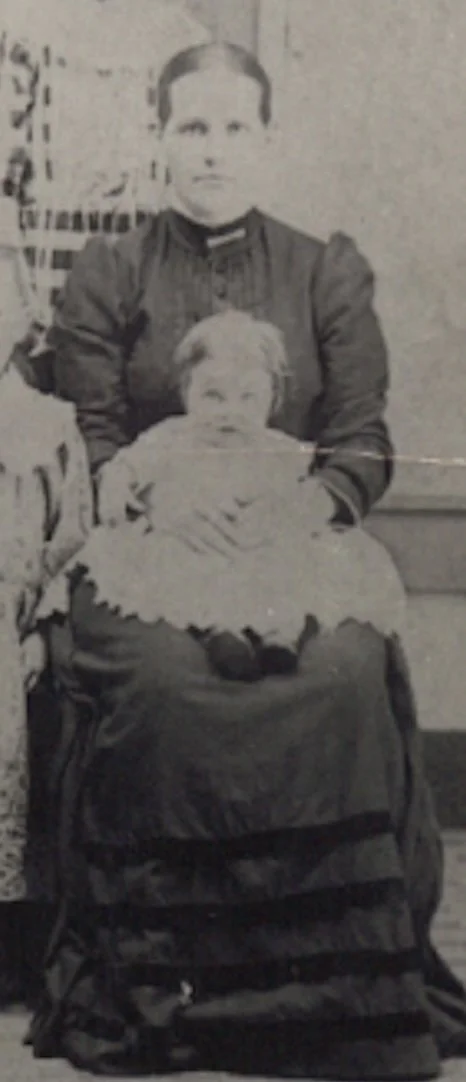
Rebecca was the wife of John Hiram Beckley, the protagonist of my upcoming historical fiction - “Gilded”. She was also the second oldest child of John Grace and Mary Ellen Moreland Brooks; their second daughter. She is pictured here with her daughter, Sarah “Annie” Beckley, on her lap in 1892.
Rebecca was the splitting image of her mother, who was quite well known in the Union Township, Carroll County, Ohio farming enclave as a “socialite”; she entertained, and her parties were popular community events. John Grace Brooks, on the other hand, carried on with the vast farmlands that had been vested in him by his ancestors who were one of the first inhabitants of “Irish Ridge”.
Rebecca was born on July 10, 1861, shortly before her father that fall was mustered in to Company G of the 15th Regiment to serve as a Private within the Infantry of the Union Army. And yet, genealogists through the years have created confusion over Rebecca’s actual date of birth. Some list the July date, but for the year 1860, whilst others give 1862 as the year of Rebecca’s birth. Careful review of the census records over the years of her life confirms that her date of birth listed on her gravestone, “1861”, is correct.
Nearly Rebecca’s entire life was spent in Union Township, first at her childhood home, which still stands today at the intersection of Route 332 (Scio Road) and Autumn Road, and then at residences approximately two miles west on Autumn Road where she raised her own family.
Rebecca’s siblings were, her older sister; Elizabeth, who died in 1915 of Bright’s Disease and heart failure; her younger sister, Ada Bell, who died along with her infant during childbirth in 1889; her youngest sister, Eva Gertrude, who was cared for by the Brooks family over the duration of her fifty years of life. Gertrude, though, led an active social life accompanying her mother right up to the last five years of her life. Rebecca’s only brother, Thomas William “Possum” Brooks, was twelve years her junior and was the only surviving member of her family at the time of Rebecca’s death.
As mentioned, Rebecca married John Hiram Beckley on May 8, 1881, and removed from her family home to work and live at one of the Brooks’ extended family members’ farms; William McQueen’s. John Hiram had been working as a farmhand at “Senator” McQueen’s property, which was located on the Orange Township/Union Township boundary, for a couple of years. It was there that the Beckley family’s first three children were born; Olive Blanche (1882); Laura Belle (1885); and Mary Eveline (1887).
In March of 1888, John Hiram and Rebecca moved on to their own parcel of land, just a tad east along Autumn Road, the former John Minor McQueen farm. It was a queer piece of land seeing how there was no road frontage to their property, but they were given easement for usage of a lane on the eastern boundary to access their log-styled farmhouse.
Five days before the Brooks and Beckley families were to celebrate Christmas in 1890, Rebecca gave birth to her only son, who was named John Ross Beckley. In January of 1892, Sarah “Annie” was born. Then, ten years later, Rebecca, at the age of forty-one, gave birth to her last child, Ruth.
The entire Beckley family moved directly across the road in the autumn of 1904 to what was the James McNulty farm. They retained their original farmhouse since the land was now freehold, and Rebecca refused to make the move to the larger home until it was brought up to her level of cleanliness.
Rebecca was an active worker on their farm in addition to keeping house and raising the children. And, when her children became older, she assisted them with their budding families. A perfect example was when her son Ross and his wife, Bertha Buxton Beckley, bought the farm on the eastern boundary of the Beckley farm in 1920. Rebecca lent a helping hand to Ross and Bertha in looking after their children and guiding Bertha with what she had learned through the years of being a farmer’s wife.
However, just before Rebecca’s 69th birthday in 1930, she experienced her first bout of heart failure. She would linger with ill health triggered by her weak heart for eight years, dying on Valentines Day in 1938. At the time of her death, Rebecca had 42 grandchildren and 15 great grandchildren. In her honor, six of the grandsons served as pall bearers at her funeral while six granddaughters were chosen to be flower bearers.
Rebecca had lived a full life in her 76 years here on earth and was a treasured member of the Palermo community and the Mt. Pleasant Methodist Church on Canyon Road, which she had been a lifelong member.
GILDED!
The Protagonist
It’s been a while since my last blog. A lot of progress has been made over the past few months toward the completion of my manuscript, “Gilded!”. There is still work to do; thoroughly researching the nearly eighty-six-year lifespan of John Hiram Beckley has been more challenging than initially thought. However, I’m sufficiently near the finish that I feel it’s time to begin introducing the cast of characters through pictures and snippets of their cameo roles within the main story.
John Hiram Beckley was born in 1857 and was Susannah Reigle Beckley’s first son; she had three daughters before him. The novelization of John Hiram’s life serves as a sequel to my first book, “Oh! Susannah”, and readers will discover ties in “Gilded!” to my earlier historical fiction work, and yet, the forthcoming book stands on its own without the need for introduction.
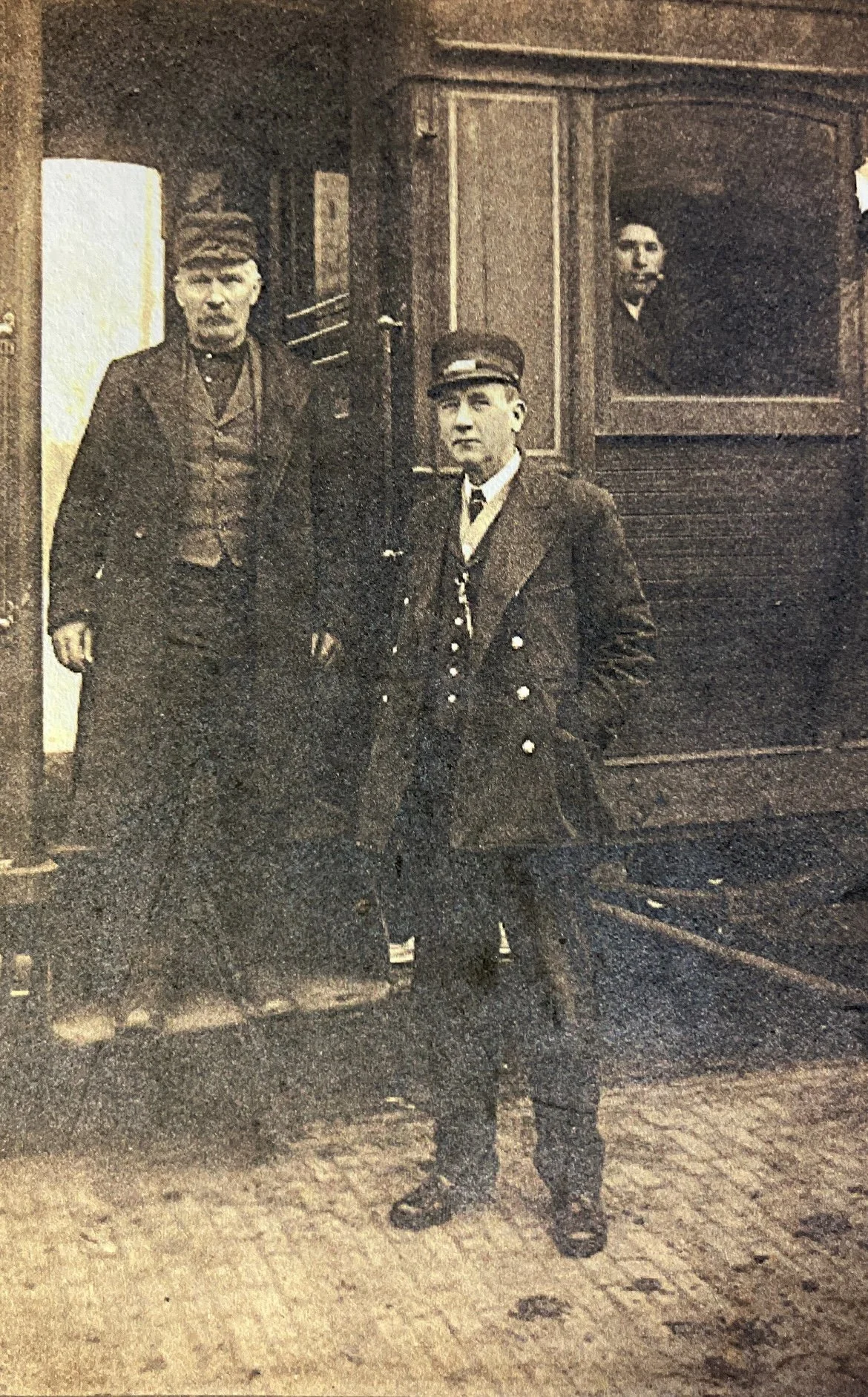
This picture shows John Hiram (on the left) as a fifty-five-year-old man who had ventured away from his farming community located in Palermo, Carroll County, Ohio, for the first time in his life. He rode a train to visit his youngest brother, Edward, in Dennison, Ohio, which is about a fifteen-to-twenty-mile trip.
Edward was a well-known person in Dennison as he labored in the town’s fire department, and he used his connections to impress his older brother. John Hiram received the “royal tour”, and one of the highlights was visiting the local theatre, where he watched a moving picture show for the first time. However, it was the ride on the city’s streetcar, pictured here, that left John Hiram awestruck. John Hiram told the local news reporter, “It was nothing like I expected. I expected to see the cars elevated. I had no idea they would be running along the ground.”
And yet, this was not the only surprise in store for John Hiram. The streetcar that January morning in 1913 had a special passenger; Albert Kail (the man in the picture on the right). Mr. Kail was an employee of the streetcar company as a conductor, and he was being reassigned back to his old route. Kail was onboard that morning familiarizing himself when he bumped into John Hiram and Edward Beckley. Introductions were made as a matter of courtesy. Then, John Hiram enquired of Albert Kail where his family was from, for he looked familiar to him. Soon the two men, John Hiram and Albert Kail, were reminiscing of their old schoolboy days in Arabia, Carroll County, from fifty years past!
Other than this trip to Dennison, Ohio, John Hiram Beckley spent his entire life within the ten-mile Carroll County, Ohio farm belt that stretched from west (Palermo) to east (Harlem Springs). His story is mainly based within the Palermo/Algonquin farming community but also touches upon national and international events that occurred between 1870 to 1943.
The middle years of Beckley’s life, commonly referred to as “The Gilded Era”, was known for this phrase accredited to author Mark Twain, from one of his early manuscripts. Twain’s objective was to sarcastically question much of the change being forced upon people during this time. “Gilded” means covered in a thin layer of gold and Twain warned the public that the chief end of men, businessmen especially, was to get rich; not necessarily improve the public’s lives. Thus, Twain’s famous quote, “What is the chief end of man? - to get rich. In what way? Dishonestly if we can; honestly if we must.”
In my story, “Gilded!”, Twain’s skepticism is lived out in John Hiram’s everyday life, and his perspective on each new and improved invention that was introduced to Americans during this time. John Hiram Beckley never used mechanized farm equipment, nor did he own or drive an automobile, despite hundreds of cars during the 1920’s being driven locally. John Hiram was eighty years old before experiencing the marvel of electricity within his farmhouse; he had no indoor plumbing. John Hiram’s efforts to live a simple life weren’t fool proof. Despite never using a bank nor investing in the stock market, his one hundred forty-three acres of Carroll County, Ohio farmland wasn’t isolated enough to totally insulate him from outside events.
I look forward to introducing to you in the coming months, through pictures, the cast of characters who interacted with John Hiram Beckley during his lifetime.